
Approximately synonym words like about, roughly, nearly, and around describe numbers, time, or amounts that are close to an exact figure but not precise. For example, “The journey took about three hours,” or “Approximately fifty people attended.”
If you’re writing estimates, comparisons, or informal measurements, each word highlights a different level of closeness—from casual guesses to more formal approximations.
In this guide, you’ll learn the meaning and example sentences for each approximately synonym, so you can express estimation and uncertainty with clarity and confidence.
What Does “Approximately” Mean?
The word “approximately” refers to something that is close to an exact number, amount, or time but not completely accurate.
Examples:
- “The package weighs approximately two kilograms.”
- “Approximately 10,000 people visited the event.”
“Approximately” is common in academic, professional, and everyday writing when exact figures are unnecessary or unknown.
Synonyms of “Approximately” with Meanings, Examples, and Usage Tips
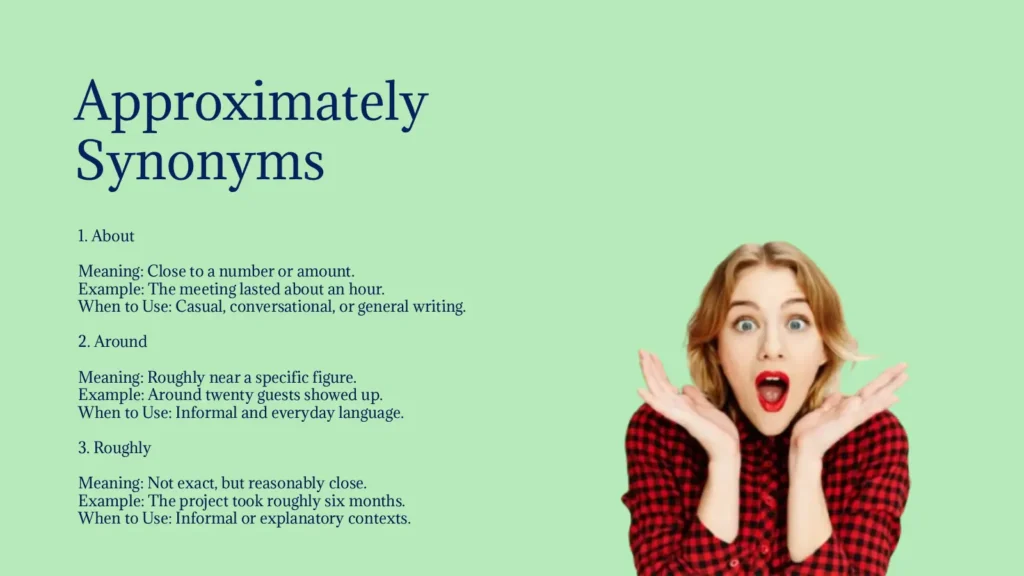
1. About
Meaning: Close to a number or amount.
Example: The meeting lasted about an hour.
When to Use: Casual, conversational, or general writing.
2. Around
Meaning: Roughly near a specific figure.
Example: Around twenty guests showed up.
When to Use: Informal and everyday language.
3. Roughly
Meaning: Not exact, but reasonably close.
Example: The project took roughly six months.
When to Use: Informal or explanatory contexts.
4. Nearly
Meaning: Very close to an exact amount.
Example: Nearly half the class passed the test.
When to Use: When emphasizing closeness.
5. Almost
Meaning: Just short of a specific amount.
Example: The bottle is almost empty.
When to Use: Conversational or narrative writing.
6. Circa
Meaning: Around a certain time or date.
Example: The building was constructed circa 1900.
When to Use: Historical or academic writing.
7. Close to
Meaning: Near a number or quantity.
Example: The cost is close to $500.
When to Use: Neutral, spoken, or written contexts.
8. More or Less
Meaning: Approximately, with flexibility.
Example: The repair took more or less two days.
When to Use: Casual or conversational tone.
9. In the Region of
Meaning: Within a general range.
Example: The temperature is in the region of 30°C.
When to Use: Formal or British English usage.
10. Thereabouts
Meaning: Around that place, time, or number.
Example: We’ll arrive at noon or thereabouts.
When to Use: Informal or narrative writing.
11. Just About
Meaning: Nearly or almost.
Example: The task is just about finished.
When to Use: Casual or spoken English.
12. On the Order of
Meaning: Rough magnitude, not precise.
Example: The population is on the order of millions.
When to Use: Scientific or technical writing.
13. Some
Meaning: An unspecified but small amount.
Example: Some fifty people attended.
When to Use: Informal estimates.
14. Estimated
Meaning: Based on calculation or judgment.
Example: The estimated cost is $2,000.
When to Use: Professional or analytical writing.
15. In the Vicinity of
Meaning: Near a particular number or amount.
Example: The price is in the vicinity of $100.
When to Use: Formal or descriptive contexts.
16. Approximately Speaking
Meaning: In general terms, not exact.
Example: Approximately speaking, sales increased.
When to Use: Explanatory or academic tone.
17. Not Far From
Meaning: Close to a specific amount.
Example: The score was not far from perfect.
When to Use: Casual or narrative writing.
18. Approaching
Meaning: Moving toward a number or limit.
Example: The temperature is approaching 40°C.
When to Use: Scientific or descriptive contexts.
19. Near Enough
Meaning: Close enough to be acceptable.
Example: The answer is near enough correct.
When to Use: Informal or conversational writing.
20. Give or Take
Meaning: Allowing small variation.
Example: It’ll take two hours, give or take.
When to Use: Casual speech or writing.
21. Bordering On
Meaning: Almost reaching a state or amount.
Example: The crowd was bordering on chaos.
When to Use: Descriptive or expressive writing.
22. In Round Numbers
Meaning: Using simplified figures.
Example: In round numbers, the cost is $1,000.
When to Use: Financial or analytical contexts.
23. Near
Meaning: Close to a value or amount.
Example: The deadline is near Friday.
When to Use: Simple and flexible usage.
24. Practically
Meaning: Almost entirely or nearly.
Example: The room was practically empty.
When to Use: Conversational or narrative tone.
25. More Than or Less Than
Meaning: Not exact, but within a range.
Example: It took more than or less than a week.
When to Use: Informal explanation.
26. Approximately Equal
Meaning: Very close in value.
Example: The two amounts are approximately equal.
When to Use: Academic or technical writing.
27. Close Enough
Meaning: Sufficiently near to be acceptable.
Example: That estimate is close enough.
When to Use: Casual or spoken contexts.
28. Something Like
Meaning: Rough similarity to a number.
Example: It weighs something like ten kilos.
When to Use: Informal or conversational tone.
29. In the Ballpark of
Meaning: Within a reasonable range.
Example: The budget is in the ballpark of $5,000.
When to Use: Business or informal professional writing.
30. Roughly Speaking
Meaning: Generally or approximately.
Example: Roughly speaking, profits increased.
When to Use: Explanatory or semi-formal writing.
Choosing the Right Synonym for “Approximately”
Selecting the right synonym depends on tone and precision:
| Tone / Context | Best Synonyms |
|---|---|
| Casual / Conversational | About, Around, Give or Take, Something Like |
| Professional / Business | Estimated, In the Ballpark of, Close to |
| Academic / Technical | Circa, On the Order of, Approximately Equal |
| Narrative / Descriptive | Nearly, Almost, Bordering On |
Cultural Tip
In academic or historical writing, “circa” and “approximately” sound polished. In everyday speech, “about” and “around” feel more natural.
Conclusion
Understanding the synonyms of approximately helps you communicate estimates clearly without overstating precision. Each word—whether about, roughly, or nearly—signals a different level of certainty.
By choosing the right synonym, you keep your writing accurate, natural, and reader-friendly. When exact numbers don’t matter, the right approximation makes all the difference.