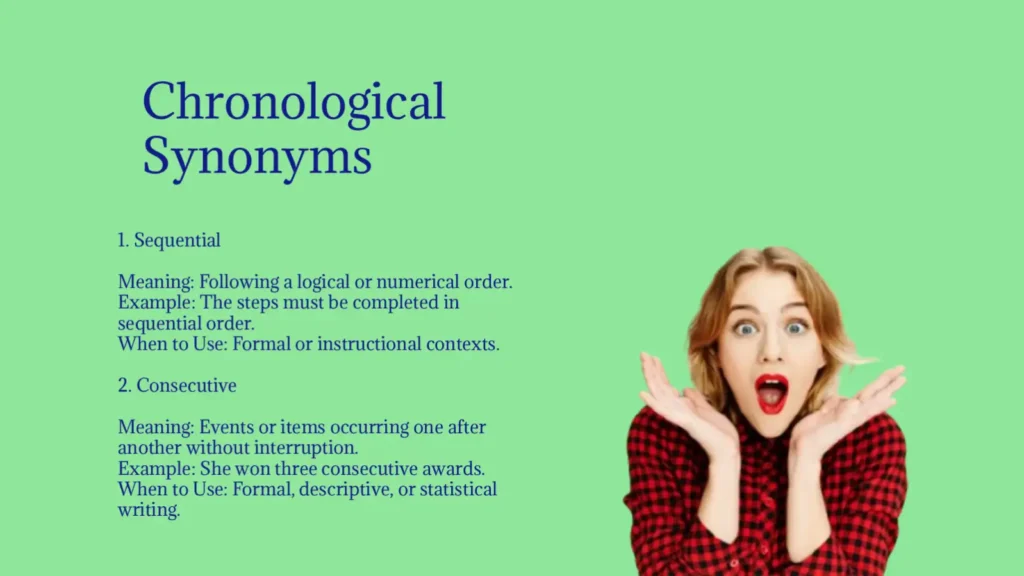
Chronological synonym words like sequential, consecutive, successive, and in order describe events or items arranged according to time or sequence. For example, “The events are listed in chronological order,” or “She told the story in successive steps.”
If you’re writing about timelines, history, or processes, each word highlights a different nuance of time—from precise sequencing to smooth progression.
In this guide, you’ll learn the meaning and example sentences for each chronological synonym, so you can express order, sequence, and timing with clarity and accuracy.
What Does “Chronological” Mean?
The word “chronological” refers to arranging events, actions, or items in the order in which they occurred, typically from earliest to latest.
Examples:
- “The report presents the events in chronological order.”
- “Please list your achievements in chronological sequence.”
Chronological order is commonly used in history, storytelling, reporting, and organization, helping readers or audiences understand progression over time.
Synonyms of “Chronological” with Meanings, Examples, and Usage Tips
1. Sequential
Meaning: Following a logical or numerical order.
Example: The steps must be completed in sequential order.
When to Use: Formal or instructional contexts.
2. Consecutive
Meaning: Events or items occurring one after another without interruption.
Example: She won three consecutive awards.
When to Use: Formal, descriptive, or statistical writing.
3. Successive
Meaning: Following in uninterrupted sequence.
Example: The successive meetings clarified all issues.
When to Use: Formal, academic, or professional tone.
4. In Order
Meaning: Arranged according to time or priority.
Example: The documents were filed in order.
When to Use: Neutral, casual, or formal writing.
5. Chronometric
Meaning: Measured or organized according to time.
Example: The chronometric timeline illustrated the project stages.
When to Use: Technical, scientific, or academic contexts.
6. Linear
Meaning: Proceeding in a straight, continuous sequence.
Example: The narrative followed a linear timeline.
When to Use: Storytelling, scientific explanation, or analytical writing.
7. Historical
Meaning: Relating to past events arranged by time.
Example: The historical record was presented in chronological order.
When to Use: History, research, or storytelling.
8. Progressive
Meaning: Moving forward step by step in time.
Example: The progressive stages of development were documented.
When to Use: Formal, educational, or process-oriented contexts.
9. Consecutively
Meaning: Done in an uninterrupted sequence.
Example: Meetings were scheduled consecutively throughout the day.
When to Use: Formal or business writing.
10. Ordered
Meaning: Arranged systematically or sequentially.
Example: The chapters were ordered by date of publication.
When to Use: Neutral, professional, or educational writing.
11. Time-Ordered
Meaning: Arranged according to the sequence of time.
Example: The emails were displayed in time-ordered format.
When to Use: Technical, analytical, or reporting contexts.
12. Serial
Meaning: Following in a sequence or series.
Example: The serial events were carefully recorded.
When to Use: Formal, literary, or analytical writing.
13. Continuative
Meaning: Continuing in sequence or time.
Example: The continuative sessions ensured full coverage.
When to Use: Academic or formal contexts.
14. Consecutive Order
Meaning: Items occurring one after another in sequence.
Example: They completed the exercises in consecutive order.
When to Use: Instructional, academic, or professional writing.
15. Successive Order
Meaning: Following one another in uninterrupted sequence.
Example: The successive order of events was clear.
When to Use: Formal or descriptive contexts.
16. Sequentially
Meaning: Arranged or occurring in sequence.
Example: Tasks were performed sequentially to maintain efficiency.
When to Use: Instructional, technical, or professional writing.
17. Time-Sequential
Meaning: Ordered according to time.
Example: The report followed a time-sequential layout.
When to Use: Scientific, academic, or formal writing.
18. Continuous
Meaning: Without interruption or break.
Example: Continuous events were documented daily.
When to Use: Neutral, descriptive, or narrative writing.
19. Ordered by Date
Meaning: Arranged according to chronological dates.
Example: Emails were ordered by date for review.
When to Use: Professional, administrative, or technical writing.
20. Serially
Meaning: In a serial or consecutive manner.
Example: The episodes aired serially every week.
When to Use: Media, formal, or narrative contexts.
21. Successively
Meaning: Following one after another in time.
Example: The awards were announced successively.
When to Use: Formal or professional contexts.
22. Linear Sequence
Meaning: Arranged in a straight, chronological order.
Example: The linear sequence of events was easy to follow.
When to Use: Analytical, academic, or technical writing.
23. Time-Based
Meaning: Organized according to time.
Example: The schedule was prepared in a time-based format.
When to Use: Professional, technical, or managerial writing.
24. Continuous Sequence
Meaning: Uninterrupted series in order.
Example: The continuous sequence of experiments provided clarity.
When to Use: Scientific, technical, or formal contexts.
25. Temporally Ordered
Meaning: Arranged based on time.
Example: The data was temporally ordered for analysis.
When to Use: Academic, analytical, or formal writing.
26. Consecutive Timeline
Meaning: A timeline without gaps in sequence.
Example: The consecutive timeline of events was documented.
When to Use: History, reporting, or process writing.
27. Successive Steps
Meaning: Steps following one another in order.
Example: The project followed successive steps for completion.
When to Use: Instructional, formal, or project-oriented writing.
28. Ordered Sequence
Meaning: Items arranged systematically in order.
Example: The files were organized in an ordered sequence.
When to Use: Professional, analytical, or academic writing.
29. Chronologically Arranged
Meaning: Items arranged by date or time.
Example: The letters were chronologically arranged for reference.
When to Use: Neutral, formal, or historical writing.
30. Progressive Order
Meaning: Following a forward-moving, stepwise sequence.
Example: The lessons were taught in progressive order.
When to Use: Educational, instructional, or formal contexts.
Choosing the Right Synonym for “Chronological”
Selecting the right synonym depends on your tone and purpose:
| Tone / Context | Best Synonyms |
|---|---|
| Neutral / Explanatory | In order, Ordered, Chronologically Arranged, Time-Ordered |
| Formal / Academic | Sequential, Successive, Temporally Ordered, Linear Sequence, Chronometric |
| Casual / Conversational | Consecutive, Successive Steps, Continuous, Progressive |
| Technical / Process-Oriented | Serial, Time-Based, Ordered Sequence, Consecutive Timeline, Continuous Sequence |
Cultural Tip
In historical or technical writing, “chronologically arranged” or “time-ordered” feels precise. In storytelling or narrative, “successive” or “progressive” gives smooth flow.
Conclusion
Understanding the synonyms of chronological helps you describe the order, timing, and sequence of events more accurately. Each word—whether sequential, successive, or time-based—captures a slightly different aspect of time progression.
By choosing the right synonym, you control clarity and tone, making timelines, instructions, or narratives precise and easy to follow. Every series of events has a chronological order—and the right word highlights it perfectly.

I am Awa White, a passionate writer who loves crafting stories that touch hearts. I explore emotions and everyday life through my words. I strive to inspire and connect with readers through every piece I write.