Homophone synonym words like sound-alike, same-sounding word, or phonetically similar term refer to words that sound the same as another word but have different meanings or spellings. For example, “pair” and “pear” are homophones, as are “flour” and “flower.”
If you’re writing about spelling, pronunciation, or wordplay, each synonym highlights a slightly different aspect—from phonetic similarity to linguistic nuance.
In this guide, you’ll learn the meaning and example sentences for each homophone synonym, so you can describe sound-alike words and linguistic relationships with clarity.
What Does “Homophone” Mean?
The word “homophone” refers to a word that is pronounced the same as another word but differs in meaning, origin, or spelling.
Examples:
- “Their” and “there” are common homophones in English.
- “Knight” and “night” sound alike but have very different meanings.
Homophones are often used in puns, poetry, spelling exercises, and language studies. They emphasize the phonetic rather than the semantic similarity of words.
Synonyms of “Homophone” with Meanings, Examples, and Usage Tips
1. Sound-Alike
Meaning: A word that sounds similar to another.
Example: “Hear” and “here” are classic sound-alike words.
When to Use: Informal or teaching contexts.
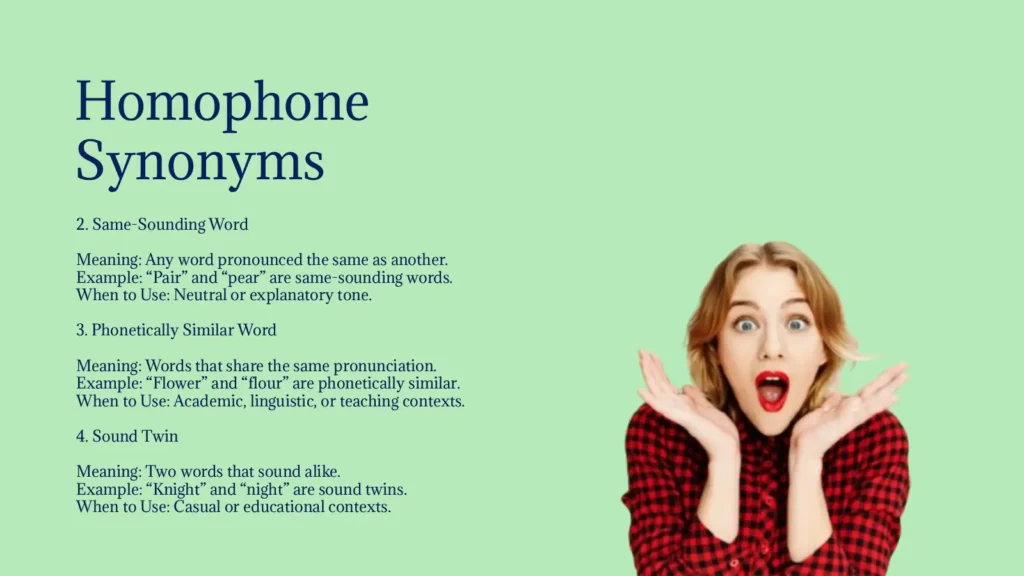
2. Same-Sounding Word
Meaning: Any word pronounced the same as another.
Example: “Pair” and “pear” are same-sounding words.
When to Use: Neutral or explanatory tone.
3. Phonetically Similar Word
Meaning: Words that share the same pronunciation.
Example: “Flower” and “flour” are phonetically similar.
When to Use: Academic, linguistic, or teaching contexts.
4. Sound Twin
Meaning: Two words that sound alike.
Example: “Knight” and “night” are sound twins.
When to Use: Casual or educational contexts.
5. Pronunciation Match
Meaning: Words pronounced identically.
Example: “Sole” and “soul” are a pronunciation match.
When to Use: Linguistic or phonetic analysis.
6. Homonym (in some contexts)
Meaning: Words that sound alike or are spelled alike, sometimes meaning the same or different things.
Example: “Bat” (animal) and “bat” (sports) are homonyms.
When to Use: Formal linguistic discussions; note: homonym can overlap with homophone but sometimes includes spelling similarity.
7. Audio Twin
Meaning: Two words that are identical in sound.
Example: “Sea” and “see” are audio twins.
When to Use: Informal or playful language learning.
8. Vocal Double
Meaning: Words that have the same vocal pronunciation.
Example: “Plain” and “plane” are vocal doubles.
When to Use: Literary or educational contexts.
9. Phonetic Equivalent
Meaning: Words that sound alike when spoken.
Example: “Mail” and “male” are phonetic equivalents.
When to Use: Linguistics, teaching, or spelling guides.
10. Echo Word
Meaning: Words that echo each other in pronunciation.
Example: “Weak” and “week” echo each other in sound.
When to Use: Creative writing or poetry contexts.
11. Tonal Match
Meaning: Words sharing the same spoken tone.
Example: “Pail” and “pail” (identical sound in context).
When to Use: Linguistic analysis, tone-focused writing.
12. Pronunciation Double
Meaning: A word sharing identical pronunciation with another.
Example: “Feat” and “feet” are pronunciation doubles.
When to Use: Teaching or phonetics.
13. Same-Sound Term
Meaning: A term pronounced the same as another.
Example: “Son” and “sun” are same-sound terms.
When to Use: Neutral, descriptive, or explanatory.
14. Homophonous Word
Meaning: Words that are homophones.
Example: “Right” and “write” are homophonous words.
When to Use: Academic, linguistic, or formal writing.
15. Phonic Twin
Meaning: Words that match phonetically.
Example: “Buy” and “by” are phonic twins.
When to Use: Casual or educational contexts.
16. Identical Sound Word
Meaning: Words sharing identical pronunciation.
Example: “Brake” and “break” are identical sound words.
When to Use: Teaching, writing, or linguistics.
17. Sonic Pair
Meaning: Two words sounding the same.
Example: “Hole” and “whole” are sonic pairs.
When to Use: Creative or informal writing.
18. Voice Match
Meaning: Words with identical vocal pronunciation.
Example: “Wear” and “where” match in voice.
When to Use: Instructional or linguistic content.
19. Verbal Twin
Meaning: Words pronounced the same verbally.
Example: “Die” and “dye” are verbal twins.
When to Use: Informal, teaching, or literary examples.
20. Same-Tone Word
Meaning: Words with identical phonetic tone.
Example: “Stair” and “stare” are same-tone words.
When to Use: Linguistics, spelling exercises, or language learning.
21. Homophonic Pair
Meaning: Two words that form a homophone.
Example: “Cell” and “sell” are homophonic pairs.
When to Use: Academic or linguistic contexts.
22. Identical Pronunciation
Meaning: Words pronounced identically but may differ in meaning.
Example: “Flew” and “flu” share identical pronunciation.
When to Use: Neutral, academic, or instructional.
23. Sound Match
Meaning: Words that match in pronunciation.
Example: “Knot” and “not” are sound matches.
When to Use: Informal or educational.
24. Pronunciation Twin
Meaning: A twin word in terms of sound.
Example: “Cite” and “sight” are pronunciation twins.
When to Use: Linguistics or teaching.
25. Echoing Word
Meaning: Words that echo each other’s pronunciation.
Example: “Hair” and “hare” are echoing words.
When to Use: Creative writing, poetry, or language learning.
26. Phonetic Match
Meaning: Words sharing the same pronunciation.
Example: “Toe” and “tow” are phonetic matches.
When to Use: Formal or educational.
27. Sound-Alike Pair
Meaning: Two words that sound alike.
Example: “Bare” and “bear” are sound-alike pairs.
When to Use: Teaching or informal writing.
28. Auditory Equivalent
Meaning: Words pronounced equivalently.
Example: “Morning” and “mourning” are auditory equivalents.
When to Use: Linguistic, poetic, or formal writing.
29. Vocal Equivalent
Meaning: Words sharing the same vocal sound.
Example: “Blue” and “blew” are vocal equivalents.
When to Use: Instructional or creative contexts.
30. Pronounced the Same
Meaning: Words that are spoken identically.
Example: “No” and “know” are pronounced the same.
When to Use: Neutral, teaching, or casual writing.
Choosing the Right Synonym for “Homophone”
Selecting the right synonym depends on your tone and purpose:
| Tone / Context | Best Synonyms |
|---|---|
| Academic / Formal | Homophonous Word, Phonetic Equivalent, Homophonic Pair, Pronunciation Match |
| Teaching / Educational | Sound-Alike, Same-Sounding Word, Phonic Twin, Vocal Double |
| Casual / Creative | Sound Twin, Sonic Pair, Echo Word, Verbal Twin |
| Neutral / Explanatory | Same-Sound Term, Identical Sound Word, Pronounced the Same |
Cultural Tip
In linguistics or formal writing, “homophonous word” or “phonetic equivalent” sounds precise. In teaching or storytelling, “sound-alike” and “echo word” feel more approachable and easy to understand.
Conclusion
Understanding the synonyms of homophone helps you describe words that sound alike but differ in meaning or spelling. Each term—whether sound-alike, phonetic equivalent, or vocal twin—captures a slightly different nuance of phonetic similarity.
By choosing the right synonym, you can improve clarity, precision, and tone in writing about language, pronunciation, or wordplay. Every homophone has a unique sound—and the right word makes it unmistakable.

I am Awa White, a passionate writer who loves crafting stories that touch hearts. I explore emotions and everyday life through my words. I strive to inspire and connect with readers through every piece I write.