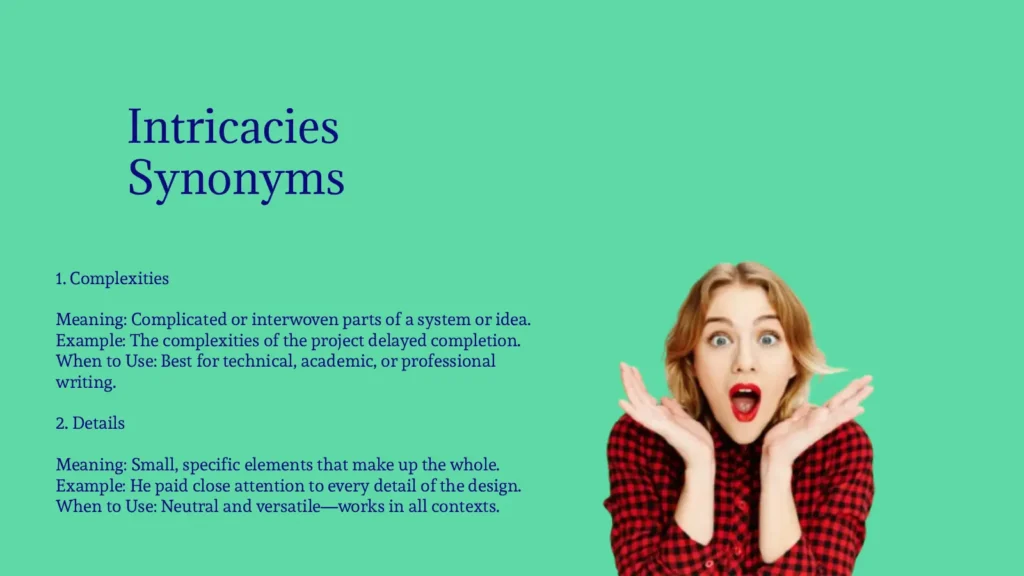
Intricacies synonyms words like complexities, details, and nuances describe the small, interconnected, or complicated parts of something. For example, “She understands the complexities of the legal system,” or “He explained the nuances of the strategy.”
When writing or speaking about systems, ideas, art, or processes, each synonym highlights a different layer of depth—from fine details to overwhelming complexity.
In this guide, you’ll learn the meaning and example sentences for each intricacies synonym, so you can express depth, detail, and complexity with clarity and precision.
What Does “Intricacies” Mean?
The word “intricacies” refers to the complex, detailed, or complicated parts of something that require careful attention to understand.
Examples:
- “The lawyer explained the intricacies of the case.”
- “She studied the intricacies of human psychology.”
“Intricacies” often suggests hidden details, layered structures, or interconnected elements. It is commonly used in academic, professional, creative, and technical contexts where surface-level understanding is not enough.
Synonyms of Intricacies with Meanings, Examples, and Usage Tips
1. Complexities
Meaning: Complicated or interwoven parts of a system or idea.
Example: The complexities of the project delayed completion.
When to Use: Best for technical, academic, or professional writing.
2. Details
Meaning: Small, specific elements that make up the whole.
Example: He paid close attention to every detail of the design.
When to Use: Neutral and versatile—works in all contexts.
3. Nuances
Meaning: Subtle differences or fine distinctions.
Example: She understood the nuances of the conversation.
When to Use: Ideal for language, culture, emotions, or analysis.
4. Complications
Meaning: Aspects that make something more difficult.
Example: Unexpected complications arose during surgery.
When to Use: Use when difficulty or obstacles are involved.
5. Subtleties
Meaning: Fine or delicate details that are not obvious.
Example: The subtleties of his acting impressed critics.
When to Use: Artistic, literary, or emotional contexts.
6. Fineness
Meaning: Delicate or precise details.
Example: The fineness of the craftsmanship stood out.
When to Use: Formal or descriptive writing.
7. Elaborations
Meaning: Detailed explanations or additions.
Example: The professor provided elaborations on the theory.
When to Use: Academic or instructional contexts.
8. Sophistications
Meaning: Advanced or refined complexity.
Example: The software’s sophistications impressed users.
When to Use: Formal, technical, or high-level discussions.
9. Layers
Meaning: Multiple levels of meaning or structure.
Example: The novel has layers of symbolism.
When to Use: Creative, analytical, or explanatory writing.
10. Entanglements
Meaning: Complex or tangled relationships or elements.
Example: The political entanglements confused voters.
When to Use: Situations involving confusion or overlap.
11. Knots
Meaning: Complicated or difficult points.
Example: The plot is full of intellectual knots.
When to Use: Informal, metaphorical, or literary tone.
12. Labyrinths
Meaning: Highly complex systems or structures.
Example: The bureaucratic labyrinths slowed progress.
When to Use: Descriptive or metaphorical contexts.
13. Refinements
Meaning: Carefully developed details or improvements.
Example: The refinements in the design enhanced usability.
When to Use: Professional, design, or creative writing.
14. Complex Networks
Meaning: Interconnected systems with many parts.
Example: Social media operates on complex networks.
When to Use: Technical or analytical writing.
15. Depths
Meaning: Profound or detailed layers of understanding.
Example: He explored the depths of philosophy.
When to Use: Reflective, academic, or literary tone.
16. Particulars
Meaning: Specific or precise details.
Example: She explained the particulars of the agreement.
When to Use: Legal, formal, or explanatory contexts.
17. Finer Points
Meaning: Small but important details.
Example: The trainer focused on the finer points of technique.
When to Use: Instructional or professional tone.
18. Technicalities
Meaning: Complex procedural or rule-based details.
Example: Legal technicalities delayed the verdict.
When to Use: Legal, bureaucratic, or formal writing.
19. Tangled Aspects
Meaning: Confusing or interwoven elements.
Example: The tangled aspects of the relationship caused stress.
When to Use: Informal or descriptive storytelling.
20. Elaborateness
Meaning: High level of detail or complexity.
Example: The elaborateness of the costume was stunning.
When to Use: Artistic or descriptive writing.
21. Fine Structure
Meaning: Small-scale internal organization.
Example: Scientists studied the fine structure of the atom.
When to Use: Scientific or technical contexts.
22. Compounded Elements
Meaning: Multiple parts combined into complexity.
Example: The issue had compounded elements of risk.
When to Use: Analytical or professional tone.
23. Hidden Details
Meaning: Details not immediately visible.
Example: The painting reveals hidden details up close.
When to Use: Creative or descriptive writing.
24. Substructures
Meaning: Underlying frameworks or systems.
Example: The substructures of society influence behavior.
When to Use: Academic or sociological contexts.
25. Complexity Layers
Meaning: Multiple levels of complication.
Example: The project involved several complexity layers.
When to Use: Technical or explanatory writing.
26. Delicacies
Meaning: Sensitive or intricate aspects.
Example: The delicacies of diplomacy require caution.
When to Use: Formal or refined tone.
27. Interconnections
Meaning: Links between parts of a system.
Example: The interconnections between events became clear.
When to Use: Analytical or educational contexts.
28. Webs
Meaning: Intricate networks or systems.
Example: The webs of intrigue fascinated readers.
When to Use: Metaphorical or narrative writing.
29. Mechanisms
Meaning: Inner workings or processes.
Example: He explained the mechanisms behind the machine.
When to Use: Technical or instructional tone.
30. Inner Workings
Meaning: The hidden or complex internal parts.
Example: The documentary revealed the inner workings of government.
When to Use: Informative or investigative writing.
Choosing the Right Synonym for “Intricacies”
Selecting the right synonym depends on tone and purpose:
| Tone / Context | Best Synonyms |
|---|---|
| Academic / Technical | Complexities, Technicalities, Substructures |
| Creative / Literary | Nuances, Layers, Webs, Labyrinths |
| Professional | Details, Particulars, Mechanisms |
| Analytical | Interconnections, Depths, Inner Workings |
| Descriptive | Subtleties, Finer Points, Hidden Details |
Cultural Tip
“Intricacies” often implies depth plus difficulty, while “details” is more neutral and accessible.
Use “nuances” for subtle meaning and “technicalities” when rules or procedures dominate the complexity.
Conclusion
Understanding the synonyms of intricacies allows you to express depth, complexity, and detailed structure with precision. Whether you choose complexities, nuances, or inner workings, each term highlights a different layer of understanding.
By selecting the right synonym, you control the tone—academic, creative, or professional—while helping readers grasp the true depth of your subject. These words remind us that mastery comes not from ignoring intricacies, but from understanding them fully.

I am Awa White, a passionate writer who loves crafting stories that touch hearts. I explore emotions and everyday life through my words. I strive to inspire and connect with readers through every piece I write.