
Reader synonym words like audience, viewer, subscriber, and follower describe people who consume written content, whether books, articles, blogs, or digital media. For example, “The article attracted a global audience,” or “Subscribers responded positively to the newsletter.”
If you’re writing about content creation, publishing, marketing, or education, each word highlights a different relationship between text and the people engaging with it.
In this guide, you’ll learn the meaning and example sentences for each reader synonym, so you can refer to your audience with clarity, accuracy, and tone control.
What Does “Reader” Mean?
The word “reader” refers to a person who reads written or printed material such as books, articles, reports, or digital content.
Examples:
- “The blog has thousands of loyal readers.”
- “She is an avid reader of historical novels.”
A reader can be casual or dedicated, digital or print-focused, and may engage for learning, entertainment, or information.
Synonyms of “Reader” with Meanings, Examples, and Usage Tips
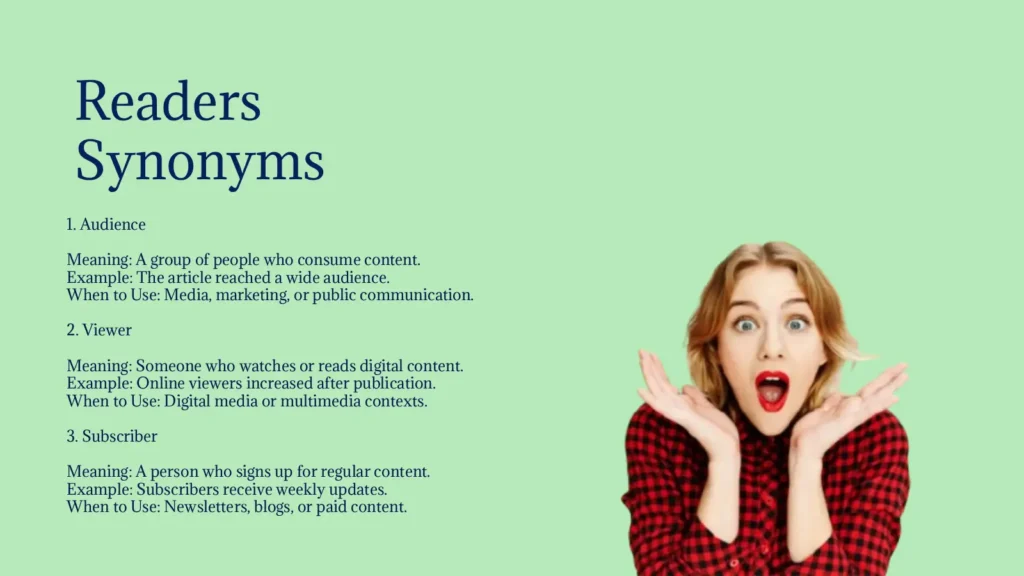
1. Audience
Meaning: A group of people who consume content.
Example: The article reached a wide audience.
When to Use: Media, marketing, or public communication.
2. Viewer
Meaning: Someone who watches or reads digital content.
Example: Online viewers increased after publication.
When to Use: Digital media or multimedia contexts.
3. Subscriber
Meaning: A person who signs up for regular content.
Example: Subscribers receive weekly updates.
When to Use: Newsletters, blogs, or paid content.
4. Follower
Meaning: Someone who regularly engages with content or updates.
Example: The writer gained new followers daily.
When to Use: Social media or online platforms.
5. Consumer
Meaning: Someone who consumes information or media.
Example: Content consumers prefer short articles.
When to Use: Marketing, analytics, or business writing.
6. Patron
Meaning: A supporter or regular user of written works.
Example: Library patrons enjoy free access.
When to Use: Libraries, arts, or cultural contexts.
7. Bookworm
Meaning: A person who loves reading frequently.
Example: She’s a true bookworm.
When to Use: Informal or friendly tone.
8. Bibliophile
Meaning: Someone who loves books deeply.
Example: Bibliophiles appreciate rare editions.
When to Use: Literary or formal writing.
9. Learner
Meaning: A person reading to gain knowledge.
Example: Learners benefit from clear explanations.
When to Use: Educational or instructional contexts.
10. Student
Meaning: Someone who reads for study or learning.
Example: Students rely on textbooks.
When to Use: Academic or educational settings.
11. Researcher
Meaning: A person reading to gather information.
Example: Researchers consult peer-reviewed articles.
When to Use: Academic, scientific, or professional writing.
12. Scholar
Meaning: A learned reader with academic focus.
Example: Scholars analyze classical texts.
When to Use: Formal or academic tone.
13. Observer
Meaning: Someone who carefully notices and interprets content.
Example: Observers noted recurring themes.
When to Use: Analytical or reflective writing.
14. Interpreter
Meaning: A reader who explains or derives meaning.
Example: Each interpreter saw the text differently.
When to Use: Literary or critical analysis.
15. Examiner
Meaning: A person who inspects content closely.
Example: Examiners reviewed the report.
When to Use: Formal, evaluative contexts.
16. Reviewer
Meaning: Someone who evaluates written material.
Example: Reviewers praised the novel.
When to Use: Publishing, media, or critique.
17. Critic
Meaning: A reader who judges quality or value.
Example: Critics admired the author’s style.
When to Use: Opinion, media, or literary analysis.
18. Enthusiast
Meaning: A highly interested reader.
Example: History enthusiasts loved the article.
When to Use: Positive, engaging tone.
19. Participant
Meaning: Someone actively involved with content.
Example: Participants engaged in the discussion.
When to Use: Interactive or community-driven content.
20. User
Meaning: A person who accesses written material digitally.
Example: Users spent more time on the page.
When to Use: Tech, UX, or analytics writing.
21. Visitor
Meaning: Someone who accesses content temporarily.
Example: Website visitors increased overnight.
When to Use: Web analytics or marketing.
22. Browser
Meaning: A casual reader who skims content.
Example: Browsers scanned headlines quickly.
When to Use: Informal or digital contexts.
23. Digest Reader
Meaning: Someone who prefers summaries.
Example: Digest readers like concise content.
When to Use: Newsletters or summaries.
24. Consumer of Content
Meaning: A broad term for anyone engaging with text.
Example: Content consumers value clarity.
When to Use: Marketing or strategic writing.
25. Knowledge Seeker
Meaning: A reader searching for information.
Example: Knowledge seekers visit educational blogs.
When to Use: Motivational or educational tone.
26. Text Consumer
Meaning: A person who reads written material.
Example: Text consumers prefer readable fonts.
When to Use: UX, design, or academic writing.
27. Literature Lover
Meaning: Someone passionate about written works.
Example: Literature lovers attend book fairs.
When to Use: Warm, descriptive tone.
28. Audience Member
Meaning: An individual within a broader audience.
Example: Each audience member reacted differently.
When to Use: Formal or media contexts.
29. End User
Meaning: The final recipient of content.
Example: End users expect accuracy.
When to Use: Technical or professional writing.
30. Readership
Meaning: The collective group of readers.
Example: The magazine has a loyal readership.
When to Use: Publishing, journalism, or analytics.
Choosing the Right Synonym for “Reader”
Selecting the right synonym depends on your tone and purpose:
| Tone / Context | Best Synonyms |
|---|---|
| Neutral / Explanatory | Reader, Audience, User, Visitor |
| Professional / Marketing | Consumer, Subscriber, End User, Readership |
| Academic / Formal | Scholar, Researcher, Examiner, Interpreter |
| Casual / Friendly | Bookworm, Browser, Enthusiast |
| Digital / Media | Viewer, Follower, Participant |
Cultural Tip
In publishing and SEO, “readership” sounds professional. In blogs and social media, “audience” and “followers” feel more natural and engaging.
Conclusion
Understanding the synonyms of reader helps you connect with your audience more precisely and professionally. Each word—whether audience, subscriber, or bibliophile—captures a different relationship between content and people.
By choosing the right synonym, you control tone, intent, and clarity, making your writing more targeted and effective. Every piece of content has readers—and the right word helps you speak directly to them.