
Waiflike synonym words like fragile, slender, and delicate describe someone who appears thin, slight, or vulnerable, often with an air of innocence or frailty. For example, “She had a fragile, waiflike appearance,” or “His waiflike frame made him seem younger than his age.”
If you’re writing about appearance, vulnerability, or subtle beauty, each word highlights a different shade of thinness—from gentle delicacy to extreme frailty.
In this guide, you’ll learn the meaning and example sentences for each waiflike synonym, so you can describe slenderness, fragility, and vulnerability with precision and elegance.
What Does “Waiflike” Mean?
The word “waiflike” refers to someone who is very thin, small, or fragile in appearance, often giving the impression of vulnerability, innocence, or neglect.
Examples:
- “The waiflike child stood quietly in the doorway.”
- “Her waiflike figure added to the character’s sense of vulnerability.”
“Waiflike” is commonly used in literature and descriptive writing and can carry emotional or sympathetic undertones.
Synonyms of “Waiflike” with Meanings, Examples, and Usage Tips
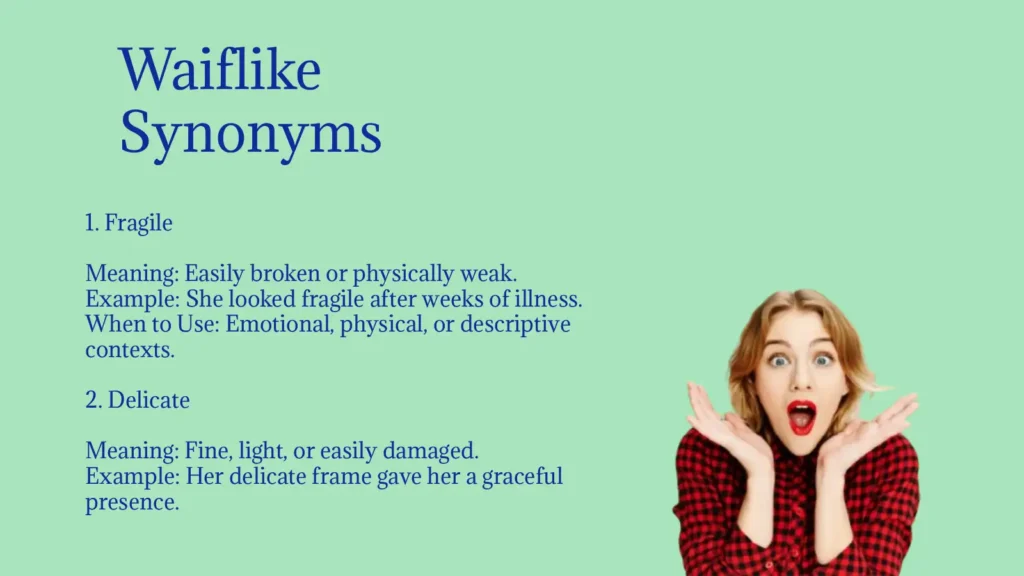
1. Fragile
Meaning: Easily broken or physically weak.
Example: She looked fragile after weeks of illness.
When to Use: Emotional, physical, or descriptive contexts.
2. Delicate
Meaning: Fine, light, or easily damaged.
Example: Her delicate frame gave her a graceful presence.
When to Use: Positive or gentle descriptions.
3. Slender
Meaning: Gracefully thin or narrow.
Example: He had a tall, slender build.
When to Use: Neutral or flattering descriptions.
4. Frail
Meaning: Weak and easily exhausted.
Example: The frail man leaned on a cane.
When to Use: Often implies age, illness, or weakness.
5. Thin
Meaning: Having little body fat or muscle.
Example: She appeared unusually thin after the journey.
When to Use: Neutral, straightforward writing.
6. Slight
Meaning: Small and lightly built.
Example: Her slight figure disappeared into the crowd.
When to Use: Literary or descriptive tone.
7. Skinny
Meaning: Extremely thin, sometimes unattractive.
Example: He was too skinny for the heavy coat.
When to Use: Informal or critical contexts.
8. Emaciated
Meaning: Abnormally thin due to illness or starvation.
Example: The emaciated dog struggled to stand.
When to Use: Serious, dramatic, or medical writing.
9. Gaunt
Meaning: Grimly thin with sharp features.
Example: His gaunt face showed years of hardship.
When to Use: Dark, dramatic, or literary contexts.
10. Willowy
Meaning: Tall, thin, and graceful.
Example: She moved with a willowy elegance.
When to Use: Positive, poetic descriptions.
11. Scrawny
Meaning: Unattractively thin and weak.
Example: The scrawny boy avoided confrontation.
When to Use: Informal or slightly negative tone.
12. Underweight
Meaning: Weighing less than what is considered healthy.
Example: The doctor noted she was underweight.
When to Use: Medical or factual writing.
13. Wispy
Meaning: Thin, light, or barely noticeable.
Example: Wispy hair framed her pale face.
When to Use: Soft, poetic descriptions.
14. Bony
Meaning: Very thin with visible bones.
Example: His bony hands trembled.
When to Use: Visual, descriptive writing.
15. Ethereal
Meaning: Extremely delicate and light, almost unreal.
Example: She had an ethereal, waiflike beauty.
When to Use: Romantic or artistic contexts.
16. Delicately Built
Meaning: Lightly and finely formed.
Example: He was delicately built but surprisingly strong.
When to Use: Formal or descriptive writing.
17. Petite
Meaning: Small and attractively thin.
Example: Her petite stature made her seem younger.
When to Use: Positive or flattering tone.
18. Lithe
Meaning: Thin, flexible, and graceful.
Example: The dancer’s lithe body moved effortlessly.
When to Use: Athletic or artistic descriptions.
19. Feeble
Meaning: Lacking physical strength.
Example: She felt feeble after the long illness.
When to Use: Physical or emotional weakness contexts.
20. Starved-looking
Meaning: Appearing extremely thin from lack of food.
Example: The refugees looked starved-looking and tired.
When to Use: Strong, emotional descriptions.
21. Ghostlike
Meaning: Pale, thin, and barely noticeable.
Example: He appeared ghostlike in the dim light.
When to Use: Atmospheric or dramatic writing.
22. Spindly
Meaning: Long, thin, and weak-looking.
Example: His spindly legs struggled under the load.
When to Use: Visual or slightly negative tone.
23. Light-framed
Meaning: Having a small, thin build.
Example: She was light-framed but energetic.
When to Use: Neutral or descriptive writing.
24. Hollow-cheeked
Meaning: Having sunken cheeks from thinness.
Example: The hollow-cheeked man looked exhausted.
When to Use: Literary or visual contexts.
25. Lean
Meaning: Thin but strong or healthy-looking.
Example: His lean physique suited the role.
When to Use: Neutral to positive tone.
26. Delicate-looking
Meaning: Appearing weak or easily hurt.
Example: She seemed delicate-looking but resilient.
When to Use: Descriptive or emotional writing.
27. Skeletal
Meaning: Extremely thin, resembling a skeleton.
Example: The skeletal figure shocked everyone.
When to Use: Dramatic or critical contexts.
28. Slight-built
Meaning: Naturally small and thin in build.
Example: He was slight-built but fast.
When to Use: Neutral or descriptive tone.
29. Paper-thin
Meaning: Extremely thin or fragile.
Example: Her paper-thin arms shook.
When to Use: Vivid, metaphorical writing.
30. Delicacy-framed
Meaning: Built with extreme lightness and fragility.
Example: The delicacy-framed girl moved softly.
When to Use: Literary or poetic contexts.
Choosing the Right Synonym for “Waiflike”
Selecting the right synonym depends on tone and intent:
| Tone / Context | Best Synonyms |
|---|---|
| Neutral / Descriptive | Thin, Slight, Slender, Lean |
| Emotional / Sympathetic | Fragile, Frail, Wispy, Delicate |
| Dramatic / Dark | Gaunt, Emaciated, Skeletal, Ghostlike |
| Positive / Poetic | Willowy, Ethereal, Lithe, Petite |
| Medical / Factual | Underweight, Feeble, Starved-looking |
Cultural Tip
In literature, “waiflike,” “ethereal,” and “willowy” feel elegant. In medical or factual writing, “underweight” or “frail” is more appropriate.
Conclusion
Understanding the synonyms of waiflike helps you describe thinness, fragility, and vulnerability with nuance and sensitivity. Each word—whether fragile, willowy, or gaunt—conveys a distinct emotional and visual tone.
By choosing the right synonym, you sharpen clarity and deepen impact, allowing readers to picture not just a body type, but a feeling and a story behind it.