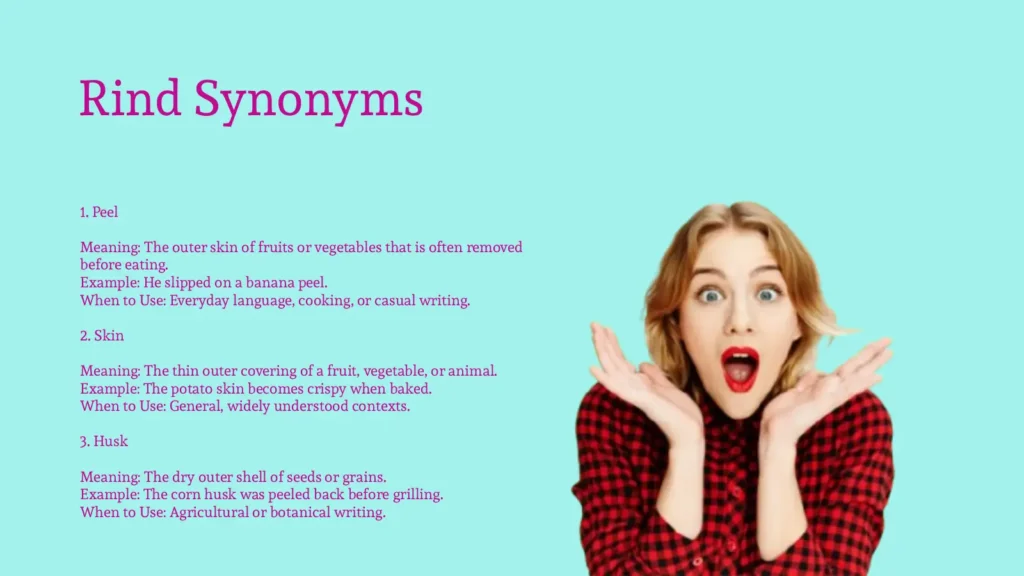

Rind synonym words like peel, skin, and husk describe the outer layer or protective covering of fruits, plants, and other objects. For example, “He removed the orange peel before eating,” or “The watermelon’s thick skin kept it fresh.”
If you’re writing about texture, protection, or natural layers, each word highlights a slightly different type of outer covering—from edible fruit surfaces to tough protective shells.
In this guide, you’ll learn the meaning and example sentences for each rind synonym, so you can describe outer layers with clarity and precision.
What Does “Rind” Mean?
The word “rind” refers to the tough outer covering or skin of fruits, vegetables, cheese, or similar items that protects what’s inside.
Examples:
- “She grated lemon rind into the cake batter.”
- “The thick rind of the melon was hard to cut.”
A rind is usually protective and sometimes inedible, though certain rinds are used in cooking for flavor or texture.
Synonyms of “Rind” with Meanings, Examples, and Usage Tips
1. Peel
Meaning: The outer skin of fruits or vegetables that is often removed before eating.
Example: He slipped on a banana peel.
When to Use: Everyday language, cooking, or casual writing.
2. Skin
Meaning: The thin outer covering of a fruit, vegetable, or animal.
Example: The potato skin becomes crispy when baked.
When to Use: General, widely understood contexts.
3. Husk
Meaning: The dry outer shell of seeds or grains.
Example: The corn husk was peeled back before grilling.
When to Use: Agricultural or botanical writing.
4. Shell
Meaning: A hard outer protective layer.
Example: The turtle retreated into its shell.
When to Use: When emphasizing strength or protection.
5. Crust
Meaning: A firm outer layer formed by baking or aging.
Example: The cheese developed a thick crust.
When to Use: Culinary or descriptive writing.
6. Bark
Meaning: The protective outer covering of a tree.
Example: The tree’s bark was rough to the touch.
When to Use: Nature or environmental contexts.
7. Cortex
Meaning: The outer layer of an organism or structure.
Example: The plant’s cortex protects inner tissues.
When to Use: Scientific or academic writing.
Read Also: Synonyms of Nuanced
8. Exterior
Meaning: The outside surface of something.
Example: The fruit’s exterior was surprisingly soft.
When to Use: Formal or descriptive contexts.
9. Outer Layer
Meaning: The topmost covering of an object.
Example: Remove the outer layer before slicing.
When to Use: Neutral, explanatory writing.
10. Covering
Meaning: Something that protects or encloses.
Example: The nut had a tough covering.
When to Use: Broad, general descriptions.
11. Coat
Meaning: A layer that surrounds or protects.
Example: The candy had a sugar coat.
When to Use: Culinary or metaphorical contexts.
12. Hull
Meaning: The outer casing of seeds or fruit.
Example: The hull of the strawberry was removed.
When to Use: Farming, gardening, or cooking.
13. Pod
Meaning: A natural outer container holding seeds.
Example: The peas were still inside their pod.
When to Use: Botanical discussions.
14. Membrane
Meaning: A thin, flexible outer layer.
Example: The orange segments were wrapped in a delicate membrane.
When to Use: Scientific or precise descriptions.
15. Layer
Meaning: A sheet or thickness covering something.
Example: The fruit had a waxy layer.
When to Use: General descriptive writing.
16. Envelope
Meaning: An outer structure enclosing something inside.
Example: The seed was protected by a natural envelope.
When to Use: Formal or scientific tone.
17. Shield
Meaning: Something that guards against harm.
Example: The thick rind acts as a shield.
When to Use: Emphasizing protection.
18. Case
Meaning: A container or outer covering.
Example: The insect emerged from its case.
When to Use: Biological or descriptive contexts.
19. Capsule
Meaning: A small enclosing structure.
Example: The plant formed a capsule around its seeds.
When to Use: Scientific writing.
20. Surface
Meaning: The outermost part of something.
Example: The melon’s surface was smooth.
When to Use: Neutral and versatile contexts.
21. Wrapper
Meaning: Something that encloses for protection.
Example: Nature gave the fruit a protective wrapper.
When to Use: Informal or metaphorical writing.
22. Coating
Meaning: A layer spread over a surface.
Example: The cheese had a wax coating.
When to Use: Food or manufacturing contexts.
23. Edge
Meaning: The outer boundary of something.
Example: The rind formed a firm edge.
When to Use: Visual or descriptive writing.
24. Frame
Meaning: A structure that supports or surrounds.
Example: The rind acts like a frame for the fruit.
When to Use: Figurative descriptions.
25. Border
Meaning: The outer limit or boundary.
Example: The dark border showed where the rind began.
When to Use: Visual or spatial descriptions.
26. Fascia
Meaning: A band or layer of tissue enclosing structure.
Example: The fascia protects inner layers.
When to Use: Technical or anatomical writing.
27. Film
Meaning: A very thin outer covering.
Example: A transparent film covered the fruit.
When to Use: Scientific or sensory descriptions.
28. Protective Layer
Meaning: A barrier that prevents damage.
Example: The protective layer keeps bacteria out.
When to Use: Educational or technical contexts.
29. Outer Skin
Meaning: The external protective surface.
Example: The outer skin was too tough to eat.
When to Use: Clear, reader-friendly writing.
30. Epicarp
Meaning: The botanical term for the outermost layer of a fruit.
Example: The epicarp gives the fruit its color.
When to Use: Academic or botanical contexts.
Read Also: Synonyms of Your
Choosing the Right Synonym for “Rind”
Selecting the right synonym depends on your tone and purpose:
| Tone / Context | Best Synonyms |
|---|---|
| Everyday Language | Peel, Skin, Outer Skin, Covering |
| Scientific / Academic | Cortex, Membrane, Epicarp, Fascia |
| Culinary Writing | Crust, Coat, Coating, Hull |
| Nature / Botanical | Husk, Bark, Pod, Capsule |
| Descriptive / Formal | Exterior, Surface, Protective Layer |
Cultural Tip
In cooking content, “peel” sounds more natural than “rind.” In scientific writing, “epicarp” or “membrane” adds precision and authority.
Conclusion
Understanding the synonyms of rind helps you describe protective layers and outer coverings more vividly. Each word—whether peel, husk, or epicarp—captures a slightly different texture, strength, or purpose.
By choosing the right synonym, you improve clarity and detail, making your writing more engaging and accurate. Every protected interior has a rind—and the right word makes that outer layer unmistakable.