
Synonyms of You such as yourself, one, and someone allow for more variation and formality in your speech or writing. If you’re repeating “you” too often or need a tone shift—whether more formal, inclusive, or indirect—this article provides 30 thoughtful alternatives. Each synonym comes with a clear meaning, a helpful example sentence, and guidance on when and where it’s most appropriate to use—be it in academic writing, instructions, conversational tone, or storytelling.
These options help tailor your message to different audiences without losing clarity or connection. Whether addressing a reader, a group, or a general subject, there’s a perfect substitute for “you” right here.
Understanding the word: “You”
The word “you” is a second-person pronoun that refers directly to the listener or reader. It’s common, flexible, and used in nearly every type of communication — personal or professional, formal or casual.
But while “you” is a neutral catch-all, it lacks the nuance that other alternatives might bring. In certain situations, you may want a word that feels more respectful, distant, affectionate, inclusive, or even poetic.
For example:
- In formal writing, “you” might feel too casual.
- In creative writing, using alternatives can build mood or deepen characterization.
- In certain dialects or cultures, variants of “you” carry emotional or social weight.
30 Alternatives to “You” — With Examples & Usage Tips
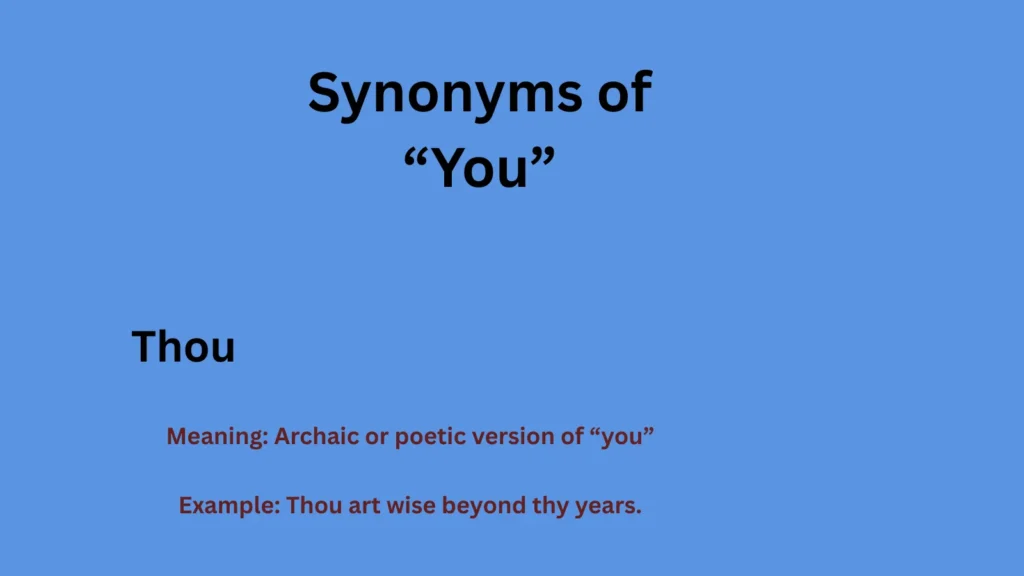
1. Thou
- Meaning: Archaic or poetic version of “you”
- Use When: Writing historical fiction or poetry
- Example: “Thou art wise beyond thy years.”
2. Thee
- Meaning: Archaic objective form of “thou”
- Use When: Writing in a biblical or old-English style
- Example: “I give this to thee.”
3. Ye
- Meaning: Archaic plural form of “you”
- Use When: Addressing groups in period writing
- Example: “Hear ye, hear ye!”
4. Y’all
- Meaning: Informal plural of “you” (common in Southern U.S.)
- Use When: Friendly, conversational, regional tone
- Example: “Are y’all coming to the game?”
5. You all
- Meaning: Plural version of “you”
- Use When: Formal version of “y’all”; inclusive
- Example: “I appreciate you all being here today.”
6. You guys
- Meaning: Informal, gender-neutral plural
- Use When: Casual conversations
- Example: “You guys need to try this!”
7. You lot
- Meaning: British English plural, slightly informal
- Use When: Conversational, often teasing
- Example: “What are you lot doing?”
8. Yourself
- Meaning: Reflexive or emphatic form
- Use When: Emphasizing individuality
- Example: “You should be proud of yourself.”
9. Thyself
- Meaning: Archaic of “yourself”
- Use When: Poetic or dramatic tone
- Example: “Know thyself.”
10. One
- Meaning: Indirect, formal alternative to “you”
- Use When: Academic or general discussion
- Example: “One should always strive to improve.”
11. Someone like you
- Meaning: Refers to “you” indirectly, often admiring
- Use When: Romantic or dramatic contexts
- Example: “I’ve never met someone like you before.”
12. Yours truly
- Meaning: Often used in letters, referring to self but implies “you” as the reader
- Use When: Formal closings
- Example: “Yours truly, John.”
13. Beloved
- Meaning: A poetic or romantic way to address someone dear
- Use When: Poetic or spiritual context
- Example: “Beloved, I am always with you.”
14. Sir/Madam
- Meaning: Formal address
- Use When: Business, polite requests
- Example: “May I help you, sir?”
15. Gentle reader
- Meaning: Used by authors addressing readers
- Use When: In essays, books, or letters to a general audience
- Example: “Gentle reader, consider this…”
16. Friend
- Meaning: Warm, inclusive tone
- Use When: Encouraging or informal messages
- Example: “Friend, you are not alone.”
17. Buddy
- Meaning: Very casual, usually male-oriented
- Use When: Friendly, laid-back interactions
- Example: “Hey buddy, can you help me out?”
18. Pal
- Meaning: Casual and friendly
- Use When: Informal conversations
- Example: “How’ve you been, pal?”
19. Mate
- Meaning: Common in British/Australian English
- Use When: Friendly, informal address
- Example: “Cheers, mate!”
20. Fellow
- Meaning: Formal or old-fashioned, usually masculine
- Use When: Group or peer discussions
- Example: “Fellow citizens, we must act now.”
21. Comrade
- Meaning: Socialist/political or military tone
- Use When: Political, ideological, or military context
- Example: “Comrade, we fight for freedom.”
22. Esteemed guest
- Meaning: Formal, respectful
- Use When: Hosting or speaking publicly
- Example: “Welcome, esteemed guests.”
23. Honored one
- Meaning: Respectful, often spiritual or ceremonial
- Use When: Religious or cultural settings
- Example: “We bow to you, honored one.”
24. Customer
- Meaning: Addressing a service user
- Use When: Business/customer service
- Example: “Dear customer, your order has shipped.”
25. Client
- Meaning: Professional service relationship
- Use When: Formal, business contexts
- Example: “As our valued client, you are entitled to…”
26. User
- Meaning: Tech-related or digital environments
- Use When: Software or UX writing
- Example: “The user can adjust their settings here.”
27. Viewer
- Meaning: Media or visual content context
- Use When: Television, YouTube, etc.
- Example: “Thank you for watching, dear viewers!”
28. Reader
- Meaning: Written content
- Use When: Blogs, books, or articles
- Example: “Dear reader, the journey begins now.”
29. Subscriber
- Meaning: Email, newsletters, or streaming platforms
- Use When: Direct communication with a follower
- Example: “As a subscriber, you get early access.”
30. Follower
- Meaning: Social media or spiritual context
- Use When: Addressing a digital or spiritual audience
- Example: “To all our followers: thank you!”
Read Also: Synonyms of Your
Choosing the Right Synonym: Tone & Context Tips
Here’s how to decide which synonym fits best:
1. Consider Tone
- Friendly/Casual: Buddy, pal, mate, you guys
- Formal/Respectful: Sir, madam, client, honored one
- Poetic/Creative: Thou, beloved, gentle reader
2. Know Your Audience
- General Public: You, you all, one
- Group Address: Y’all, you lot, fellow citizens
- Romantic or Intimate: Beloved, someone like you
3. Respect Cultural Context
- “Y’all” feels warm in the American South but might be seen as informal elsewhere.
- “Mate” works in Australia but can feel jarring in U.S. business contexts.
- “Comrade” may evoke political implications based on regional history.
4. Match the Medium
- Emails or Customer Service: Dear customer, valued client
- Fiction or Essays: Thou, gentle reader, beloved
- Tech Documentation: User, viewer, reader
Read Also: Synonyms of Nuanced
Conclusion: The Art of Addressing “You”
“You” is a word that bridges gaps, connects people, and personalizes language. But when you replace it with a more tailored alternative, you can elevate your tone, strengthen your message, and connect more meaningfully with your audience.
Choosing the right synonym for “you” isn’t about sounding fancy — it’s about being intentional. Whether you want to be warm, witty, respectful, or poetic, the right word exists.
So the next time you’re writing something important, ask yourself:
Who am I speaking to — and how do I want them to feel?
With that answer in mind, you’ll always choose wisely.